Leopard Gecko vs Crested Gecko: Which Is Better for Beginners?
Heads up: Terrarium Tested is reader-supported, and we may earn a commission if you buy through links on this page, at no extra cost to you. As an Amazon Associate I earn from qualifying purchases. Read our affiliate disclosure.
Leopard gecko vs crested gecko is the question almost every new gecko keeper asks. Both are hardy, both are calm, both have huge morph communities and tons of good care info. But they’re very different animals. One lives on the ground in a warm, dry setup and eats live insects. The other climbs, jumps, likes it cooler and can live on a powdered diet. Picking the right one comes down to your home, your schedule and what you want out of the pet.
Where this comes from: a comparison based on widely referenced care guidance for both species and common keeper experience. It’s general information, not veterinary advice.
Quick comparison
| Leopard gecko | Crested gecko | |
|---|---|---|
| Origin | Dry grasslands and rocky areas of Pakistan, Afghanistan, NW India, Iran | Rainforests of New Caledonia |
| Lifestyle | Terrestrial, crepuscular | Arboreal, nocturnal |
| Adult size | About 7-10 inches | About 7-9 inches with tail |
| Lifespan | Commonly 15-20 years | Commonly 15-20 years |
| Enclosure | Long: 36″x18″x18″ minimum, 48″x24″x24″ recommended | Tall: 18″x18″x36″ minimum (ReptiFiles’ current figure) |
| Temperatures | Basking 94-97°F, cool side 70-77°F | Basking 82-85°F at the top, 70-75°F lower down, nights 65-72°F; avoid sustained temps above 85°F |
| Humidity | 30-40% plus humid hide | 60-80%, drying to about 50% between mistings |
| Diet | Live insects | Powdered complete diet plus optional insects |
| Handling | Usually slow and easy | Jumpy; better for short sessions |
Temperament and handling
This is where people’s opinions get strong. Leopard geckos are often called the best “hands-on” lizard. They move slowly, tolerate handling well once they’re used to you, and rarely bite. They’re a solid pick if you want a pet you can hold on the couch.
Crested geckos are calm too, but they’re jumpers. Handling a crestie often looks like “hand walking,” where the gecko hops from one hand to the next. They can drop their tail if stressed or grabbed, and unlike leopard geckos, crested geckos don’t regrow it. Most adults in the hobby are tailless and doing fine, but it’s worth knowing.
Setup and space
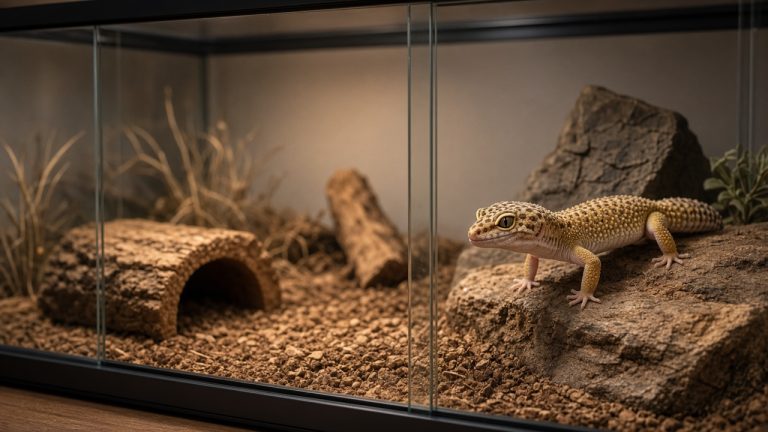
A leopard gecko needs floor space and a heat gradient. That usually means a 36″- or 48″-long enclosure with an overhead heat lamp, low-level UVB, thermostats and three hides. Our leopard gecko setup checklist lists everything.
A crested gecko needs height, branches and plants, and a way to keep humidity up. Their heat needs are mild, usually a low-wattage bulb (ReptiFiles suggests starting at about 25 watts) to create an 82-85°F basking area at the top. Overheating is the bigger risk than cold. See our crested gecko enclosure guide.
Feeding
Leopard geckos are insectivores. You’ll be buying or breeding crickets, dubia roaches, mealworms or black soldier fly larvae, gut-loading them, and dusting with calcium. If bugs gross you out, that’s a real consideration.
Crested geckos can thrive on complete powdered diets like Pangea or Repashy mixed with water a few times a week. ReptiFiles still recommends insects about once a week for exercise and enrichment. Avoid mealworms and superworms for cresties, since they can be hard to digest. Our crested gecko food guide compares brands.
Climate: which suits your home?
Hot home (regularly in the 80s°F)? Crested geckos can struggle, since sustained temps above 85°F risk heat stress, so you’d need to cool their room. Leopard geckos handle warmth better.
Cold home (below 68°F in winter)? Both will need heat, but leopard geckos need a stronger heat source. Crested geckos need a gentle basking bulb.
Dry climate? Leopard geckos fit naturally. Crested geckos need more misting or a PVC enclosure to hold humidity.
Activity: when will you see them?
Leopard geckos are crepuscular, active at dusk and dawn. You’ll often see them come out in the evening and wander around. Crested geckos are nocturnal and tend to sleep stuck to the glass or tucked in leaves all day, then come alive after lights out. If you’re mostly home in the evening, both work. If you go to bed early, a leo might suit you better.
Cost to set up
Both are similar overall. A leopard gecko usually needs more heating equipment and a longer enclosure. A crested gecko may need a tall enclosure and a misting routine but often less heat. Prices for the animals themselves vary a lot by morph and breeder.
Health concerns
Leopard geckos commonly run into problems from incorrect heat, impaction from loose substrate in poor setups, and metabolic bone disease from missing calcium. Crested geckos most often have problems from overheating, stuck shed, and metabolic bone disease from improper diet. Find an exotics vet before you buy, not after.
So which is better for beginners?
Choose a leopard gecko if you want a gecko you can hold regularly, you’re fine with feeding live insects, and you have floor space for a long enclosure.
Choose a crested gecko if you want a lush, planted display, you’d rather not deal with insects every week, your home doesn’t run hot, and you’re happy watching more than holding.
Honestly, neither is a wrong choice. Plenty of keepers end up with both.
Noise, smell and mess
Both are quiet. Crested geckos may make a soft chirp or bark now and then, and leopard geckos occasionally squeak when annoyed. Neither has much smell if you spot-clean regularly. Leos tend to pick one corner as a bathroom, which makes cleanup easy. Crested geckos poop wherever they happen to be, including on the glass, so expect to wipe the front more often.
Time commitment week to week
A leopard gecko usually means feeding insects a few times a week (less often for adults), keeping a feeder colony or buying insects regularly, checking temps, and refreshing the humid hide. A crested gecko usually means mixing food two or three times a week, misting once or twice a day, and wiping the glass. Both need fresh water and spot-cleaning. Neither takes much more than 10-15 minutes on a typical day.
Lighting and heat side by side
Both species benefit from low-level UVB, per current ReptiFiles guidance, but the setups look different. A leopard gecko gets a halogen or incandescent heat bulb over a basking stone at one end of a long enclosure, with a ShadeDweller-type T5 next to it. A crested gecko gets a gentle low-wattage heat bulb and a short ShadeDweller at the top of a tall enclosure, where it basks on branches. Both should run on a timer of about 14 hours in summer and 10-12 in winter, with no colored night bulbs.
Tail loss: the difference people forget
Leopard geckos can drop their tail and grow it back, though the regrown tail looks smoother and stubbier. Crested geckos don’t regrow it at all. A tailless crestie is perfectly healthy; it’s just permanent. If you have young kids who’ll want to grab and squeeze, that’s one more point in favor of a leopard gecko.
FAQ
Is a leopard gecko or crested gecko easier?
Both are beginner-friendly. Crested geckos can be easier if your home doesn’t run hot and you’d rather feed mostly powdered diet.
Which gecko is friendlier?
Leopard geckos are usually easier to handle. Crested geckos are calm but jumpy.
Can leopard geckos and crested geckos live together?
No. They need completely different environments and should never share an enclosure.
Which gecko lives longer?
Both commonly live 15-20 years with good care.