Leopard Gecko Temperature and Humidity: The Complete Guide
Heads up: Terrarium Tested is reader-supported, and we may earn a commission if you buy through links on this page, at no extra cost to you. As an Amazon Associate I earn from qualifying purchases. Read our affiliate disclosure.
Getting leopard gecko temperature and humidity right is the single most important part of keeping one healthy. Leopard geckos (Eublepharis macularius) are ectotherms: they rely on their environment to digest food, fight off illness and stay active. Get the numbers wrong and you’ll see it fast in their appetite and shedding. Here’s what to aim for, how to measure it, and how to fix it when it’s off.
Where these numbers come from: they reflect current, widely referenced leopard gecko care guidance (such as ReptiFiles and other keeper-led care sources) and veterinary husbandry recommendations. Individual setups vary, so always confirm with your own thermometers.
Leopard gecko temperatures at a glance
| Zone | Target |
|---|---|
| Basking surface (warm side) | 94-97°F |
| Warm hide | 90-92°F |
| Cool side | 70-77°F |
| Night | Can drop as low as 60°F |
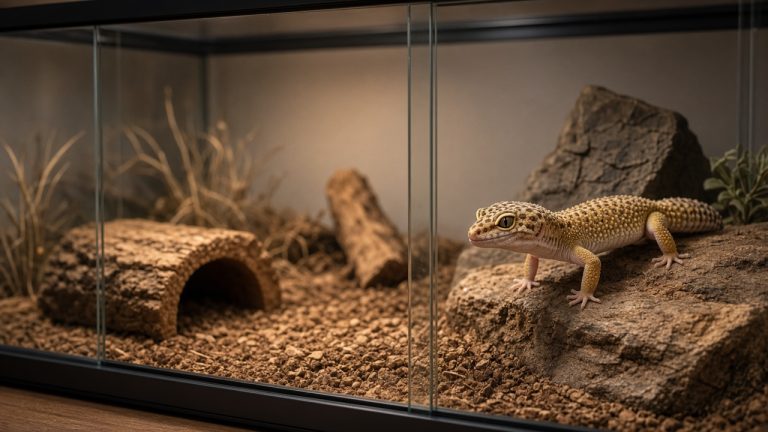
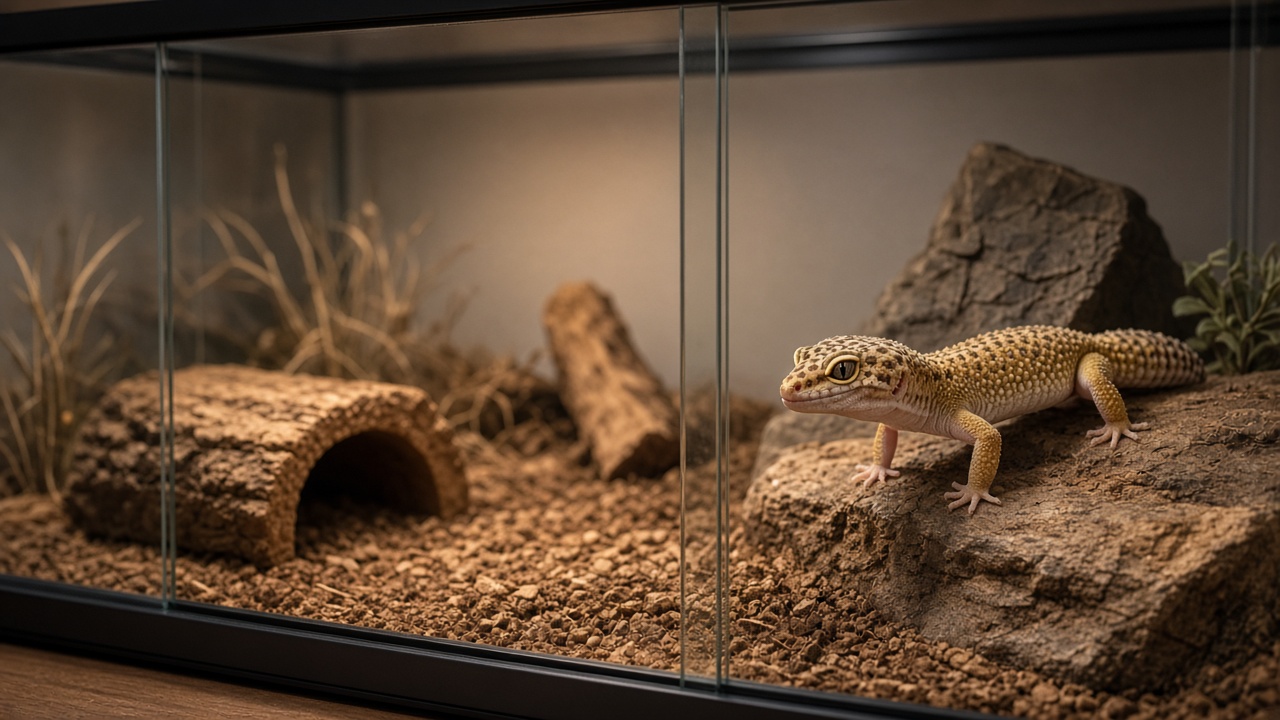
The key word is gradient. Your gecko should be able to walk from hot to cool and pick what it needs. That’s why enclosure length matters; a 36″ or 48″ enclosure makes a gradient much easier than a short tank. Our enclosure guide covers sizing.
Why the basking spot matters
A leo that can’t get warm enough won’t digest properly. You might see regurgitated food, undigested insects in poop, or a gecko that stops eating. On the other hand, a basking spot that’s too hot (over about 100°F) can cause burns and stress. The 94-97°F range gives them a strong heat source to warm up quickly after eating, then they move away.
Best heat sources
Halogen and incandescent heat bulbs
ReptiFiles calls halogen and incandescent heat bulbs the best heat source for leos. They put out IR-A and IR-B, the same heat wavelengths as sunlight, which warms the gecko from above. Over mesh, it names halogens like the Reptile Systems Eco Halogen and Arcadia GoldenSun, with about 50 watts as a starting point in an 18″-tall enclosure. For bulbs mounted inside, it suggests basking spot bulbs like the Exo Terra Intense Basking Spot (75-100 watts), always with a bulb cage. Its top pick is the pricier Reptile Systems Gold Infrared lamp. Use a well-made deep dome with a ceramic socket, such as the Zoo Med Mini Combo Deep Dome, and control the bulb with a dimming thermostat.
Deep heat projectors (DHP)
A deep heat projector, like the Arcadia Deep Heat Projector, puts out infrared heat with no visible light. It can be used day or night. ReptiFiles says DHPs must be connected to a proportional dimming thermostat, such as a Herpstat 1.
Heat mats
You don’t strictly need “belly heat” if the basking area and warm hide reach 90-92°F. Heat mats are still handy for warming the warm hide, set under it with about 1″ of substrate on top. They must be on a thermostat. See our thermostat guide for picks.
Ceramic heat emitters
Ceramic heat emitters put out only IR-C, the weakest infrared, so they’re poor as a main basking heat. They’re good at raising air temperature, though, which is why ReptiFiles recommends one in a wire cage fixture for night heat in a very cold home. Skip red, blue and black “night” bulbs, because geckos can see them and they disrupt sleep.
Whatever you use, avoid heat rocks. They’re a burn risk.
Day and night cycle
Run lights on a timer for about 14 hours a day in summer and 12 in winter, which is the photoperiod ReptiFiles gives from Dr. Frances Baines’ UV Tool. A night drop is healthier than holding daytime temperatures, and leos tolerate nights down to about 60°F. If your house gets colder than that, add a ceramic heat emitter or deep heat projector on a thermostat.
Leopard gecko humidity
Leopard geckos come from dry regions of Pakistan, Afghanistan, northwest India and Iran, but they’re not desert sand-dwellers in the cartoon sense. They spend the day in burrows and crevices where it’s much more humid than the surface.
- Ambient humidity: 30-40% in the daytime, which usually matches a typical home. Short spikes above that are fine if the enclosure is well ventilated.
- Humid hide: 70-80%, made with a hide lined with moistened substrate and placed between the middle and cool end. ReptiFiles warns against sphagnum moss and shredded paper towels, because geckos have swallowed them and developed blockages.
The humid hide is non-negotiable. It’s where they go to shed, and without it you’ll see stuck shed on toes and the tail tip, which can cut off circulation.
How to measure temperature and humidity
- Infrared temperature gun: measures surface temps, like the basking rock. The Etekcity Lasergrip is a popular budget option.
- Digital probe thermometers: one on the warm side, one on the cool side.
- Digital hygrometer: analog dial gauges are often inaccurate. Digital units from brands like Govee, ThermoPro or Inkbird are common choices.
Measure at gecko level, not near the top of the enclosure.
Troubleshooting
Basking spot too cool
Raise the basking rock or slate closer to the lamp, use a higher-wattage halogen, or check that your thermostat probe isn’t placed somewhere cooler than the basking spot.
Whole enclosure too hot
Lower the wattage, add ventilation, or move the enclosure away from windows and heater vents.
Humidity too high
Increase ventilation, remove large water dishes from the warm side, and avoid misting the whole enclosure.
Humidity too low
Keep the humid hide moist and consider a slightly damp lower layer of soil substrate. You don’t need to raise the whole enclosure much.
Stuck shed
Check the humid hide. A short, lukewarm soak and a damp cotton swab can help loosen it. If it’s stuck around toes and doesn’t come off, see a reptile vet.
Signs your temps are off
- Always hiding on the warm side: possibly too cool overall
- Always on the cool side and gaping its mouth: too hot
- Refusing food or regurgitating: often temperature-related
- Lethargy during their active hours at dusk
Also check the UVB side of the setup; our UVB guide covers placement next to the basking spot.
Seasonal changes in your home
The same setup can behave very differently in July and January. In summer, your room might sit in the high 70s°F, so the cool side may be warmer than you want and the halogen may need less wattage. In winter, a drafty room can drop the cool side into the 60s°F during the day. Check temps at least once a week, and more often when the seasons change. A dimming thermostat on your halogen does a lot of the adjusting for you, which is one of the best reasons to use one.
FAQ
What temperature should a leopard gecko tank be?
A basking surface of 94-97°F, a warm hide of 90-92°F and a cool end of 70-77°F, with nights down to about 60°F.
Can leopard geckos get too cold at night?
Yes. Below about 60°F, add a ceramic heat emitter or deep heat projector on a thermostat.
What humidity is best for leopard geckos?
About 30-40% ambient, with a humid hide at 70-80%.
Do leopard geckos need a heat lamp or a heat mat?
ReptiFiles recommends a halogen or incandescent heat lamp as the main source. A heat mat can help bring the warm hide up to temperature. Both need thermostats.