Best UVB for Leopard Geckos: Bulbs, Strength and Placement
Heads up: Terrarium Tested is reader-supported, and we may earn a commission if you buy through links on this page, at no extra cost to you. As an Amazon Associate I earn from qualifying purchases. Read our affiliate disclosure.
Looking for the best UVB for leopard geckos? Good, because the old line that “leos don’t need UVB” has mostly faded. Leopard geckos are crepuscular, so they’re out at dusk and dawn when there’s still some UV in the sky. Low-level UVB lets them make their own vitamin D3, and a lot of keepers see more natural behavior once it’s added. The catch is that it has to be the right type, the right strength, and in the right spot.
How we picked: researched picks based on manufacturer specs, published UV guidance for crepuscular reptiles (including the Ferguson zone system used by reptile vets and researchers), and widely referenced care guides like ReptiFiles. We have not measured these bulbs ourselves with a UV meter, so we won’t quote UV index readings as our own.
Do leopard geckos really need UVB?
Strictly speaking, leopard geckos can survive without UVB if they get calcium with D3 supplements. Plenty did for decades. But “survive” is a low bar. Current care guidance increasingly recommends low-level UVB because it gives the gecko a natural way to regulate D3, supports a healthy day-night cycle, and helps them see their environment the way they evolved to. Reptiles can see UVA, which is part of how they read their world.
If you add UVB, you can usually cut back on D3 in supplements. Talk to your exotics vet if you’re unsure about your dusting schedule.
What kind of UVB is best: linear tube vs compact coil
Go linear. A T5 HO (high output) or T8 linear tube spreads UVB across a wider area, which creates a gradient the gecko can move through. Compact coil bulbs throw a narrow, uneven beam and have a mixed reputation in the hobby. Most current guides recommend skipping them.
T5 HO tubes are stronger and last longer than T8s. For a leopard gecko, you want a low-strength T5 HO, or a T8 at a shorter distance.
How strong should it be?
Leopard geckos fall into Ferguson zone 1 (shade dwellers, crepuscular). ReptiFiles, citing reptile vet Dr. Frances Baines, puts the basking UV index for normally pigmented leos at 0.5-1.5, and no more than 0.5-0.7 for albino, patternless and other low-pigment morphs. Everywhere else should be shade. In practice that means a low-output T5 such as the ShadeDweller 7% or ShadeDweller Max 2.5%, set at the right distance.
Researched picks
Arcadia ShadeDweller ProT5 kit (7%) and ShadeDweller Max (2.5%)
Arcadia designed the ShadeDweller line specifically for crepuscular and shade-dwelling reptiles like leopard and crested geckos. The ShadeDweller ProT5 kit uses a short 7% T5 tube, and the ShadeDweller Max is a longer (22-24″) 2.5% tube that spreads gentle UV over more of the enclosure. Both are standard-output T5s, not HO. ReptiFiles’ rough distance guide for normally pigmented leos is 10-18″ from the basking spot for the 7% over mesh (12-20″ with no mesh), and 8-14″ for the Max 2.5% over mesh (10-18″ with no mesh). Add 1-2″ to allow for the gecko’s height. Arcadia now also sells app-dimmable LumenIZE versions.
Arcadia 6% T5 HO D3 Forest
The Arcadia 6% Forest is a full HO tube, so it’s much stronger than the ShadeDweller. It can work in taller enclosures or mounted high over mesh, but follow Arcadia’s distance chart carefully, and check with a meter if you can.
Zoo Med ReptiSun T5 HO 5.0
The Zoo Med ReptiSun 5.0 T5 HO is easy to find in US stores and is a common pick for leopard geckos. Pair it with a reflector fixture like the Zoo Med ReptiSun T5 HO terrarium hood or a separate reflector.
Zoo Med ReptiSun 5.0 T8
If you want lower output and don’t mind replacing it more often, a T8 tube is a gentler option, especially for shallow 18″-tall enclosures.
What size tube for my enclosure?
A common rule of thumb is a tube about half to two-thirds the length of the enclosure, placed on the warm side alongside your heat lamp so the gecko gets heat and UV in the same zone.
| Enclosure | Suggested tube length |
|---|---|
| 36″ x 18″ x 18″ | About 22″ (18-24″) |
| 48″ x 24″ x 24″ | About 22-34″ |
For the 20-gallon long tank folks search for, a short T5 or T8 around 12-18″ can work, but remember 20 gallons is below the adult minimum. Our enclosure guide explains why.
Mounting distance and mesh
Mesh screen blocks a chunk of UVB, and how much depends on the brand. Figures reported by the Reptile Lighting group and published by ReptiFiles range from about 18% (Kages) to 34-35% (Zoo Med, Exo Terra) and 45% (Zen Habitats, Repti Zoo). That’s why a stronger bulb may be fine on top of a screen, while the same bulb inside the enclosure might be too much. Follow the manufacturer’s distance chart for your bulb and placement.
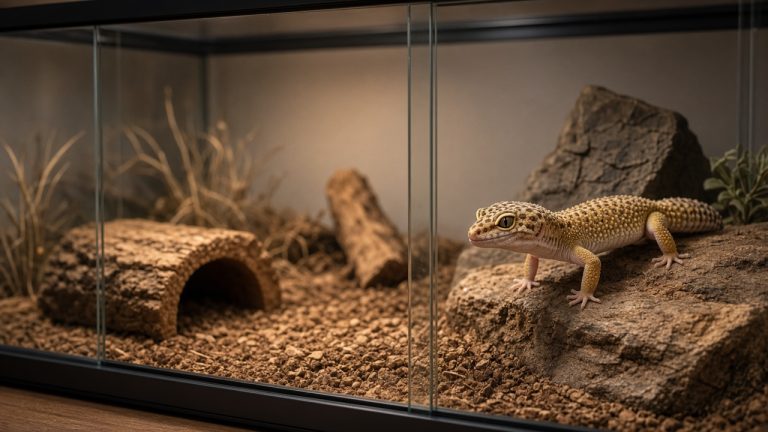
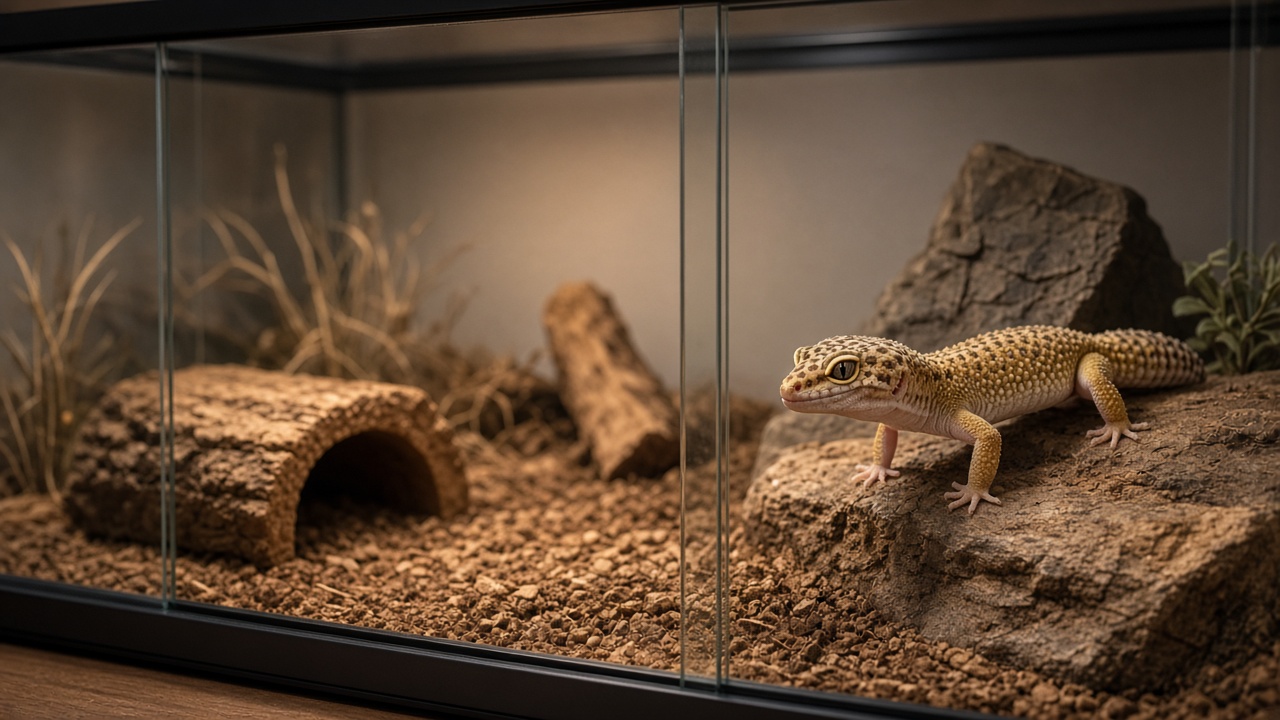
Always leave a shaded area. Hides, cork bark, plants and rocks give your gecko a choice, which is the whole point of a gradient. If you can, a Solarmeter 6.5 UV index meter takes the guesswork out, though it’s an investment.
Albino and light-sensitive morphs
Albino leopard geckos (Tremper, Bell and Rainwater lines) and some other morphs can be more sensitive to bright light. Many keepers use the lowest output option, place it over mesh, and make sure there’s deep shade available. Watch your gecko: if it squints constantly or avoids the lit side entirely, dial it back.
Light schedule
Run UVB on the same timer as your day lighting, about 14 hours in summer and 12 in winter, which is the photoperiod ReptiFiles gives from Dr. Baines’ UV Tool. ReptiFiles also suggests switching UVB on a little after the heat lamp and off a little before it. A simple outlet timer works fine. Turn it off at night along with your heat lamp; leos can handle a night drop to about 60°F. Below that, use a non-light heat source such as a ceramic heat emitter. Our temperature guide has the numbers.
When to replace UVB bulbs
UVB output drops over time even when the bulb still glows. ReptiFiles says T5 tubes should be replaced every 12 months. T8 tubes usually need replacing sooner, so check your bulb’s instructions. Mark the install date on the fixture with a piece of tape.
Building the light and heat bank
Here’s a simple layout that works in a 36″ or 48″ enclosure. Put a halogen flood lamp over a flat basking stone on one end. Mount the UVB tube right next to it, running toward the center, so the brightest UV and the warmest spot overlap. Leave the far third of the enclosure shaded and cooler, with a cool hide and plenty of clutter. That way, the gecko can choose: bask under both, sit in partial light, or hide completely. If you’re running a heat mat too, keep it under the warm hide, not across the whole floor.
FAQ
Can I use a coil UVB bulb for a leopard gecko?
It’s not recommended. Linear tubes give a more even, safer gradient.
Is 10% UVB too strong for a leopard gecko?
Often, yes, unless it’s mounted high and over mesh. Most leo keepers use a ShadeDweller 7% or ShadeDweller Max 2.5% at the recommended distance.
Should UVB be on the warm side?
Yes. Put UVB and heat together so your gecko basks in both, with shade available nearby.
Do I still need calcium with D3 if I use UVB?
Keep using plain calcium. You can usually reduce D3 supplements; ask your vet for a schedule.